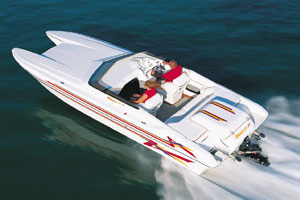
Profile 28' Cat: Performance Test
Profile's 28' Cat offers a wild ride.
January 21, 2002

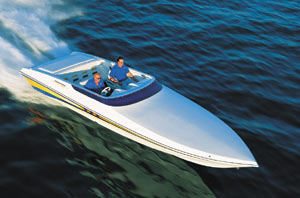
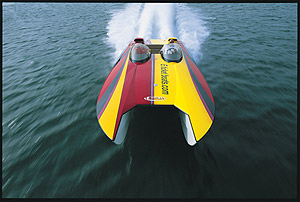
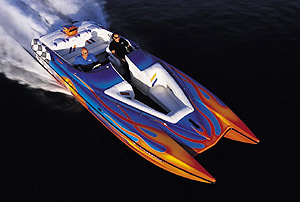
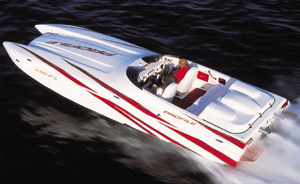
Top for the Profile 28' Cat was 94.6 mph. (All photos by Tom Newby)
You've heard the expression "Speed thrills." Here's another one for you aquatic velocity junkies: "Speed bills." That means, as you surely know, it takes big bucks to go fast on the water. Looking to run 100 mph? Look to spend at least $100,000—and that's a real bargain these days.
The 28' Cat from Profile Offshore Powerboats fits that description. Outfitted with a 650-hp naturally aspirated engine from M & J Motorworks, the 28'2"-long, 8'6"-wide cat has 100-plus-mph capability and the stability and construction quality to handle that kind of speed in decent water.
Equipped with that engine and other options, the 28' Cat arrived at the Captiva Island, Fla., leg of our 2001 Performance Trials with a $102,620 sticker. Base price for the catamaran with a 470-hp Mercury Racing HP500EFI motor is $86,521.
Performance
Let's get this said up front: The 2- to 4-foot, hole-filled slop and 20-knot winds at Captiva Island, Fla., were nowhere near ideal for testing this 28' cat. Very few catamarans in this size range can handle such conditions and they were a bit much for our test boat. We're certain that top speed and ride quality would improve dramatically in calmer water such as 1- to 2-foot chop.
A modified tunnel boat with a center pod, the 28' Cat's bottom had two sponsons, each with two three-quarter-inch-tall steps, a notch and a full-length strake. The center pod was approximately 20 inches wide and 6 inches tall.

Engine compartment rigging proved to be the highlight of the boat.
To this package the manufacturer married the 650-hp motor. The 572-cubic-inch, tall-deck engine was outfitted with a Holley Pro Series 1050 carburetor, Ross 91 pistons, Carrillo rods, a Lunati crank, a Crane roller cam, Merlin heads, a Dart intake manifold and CMI exhaust. Transferring the power to the boat's Mercury 15 1/2" x 33" four-blade stainless-steel cleaver propeller was a Marine Drive BX 2000 drive with a 1.46:1 reduction.
We were able to get a top speed of 94.6 mph at 5,000 rpm out of the cat—some mph (and 400 rpm) less than the manufacturer's top-end estimate. The rough conditions prevented our lead test driver from keeping down the throttle long enough to get the most out of the cat. Given better conditions, he said, the boat easily would run beyond the century mark.
What might also improve in calmer seas was the 28' Cat's time to plane of 9.4 seconds. However, there wasn't significant loss of visibility as it climbed on top of the water. Midrange acceleration numbers were solid, because the cat ran from 30 to 50 mph in 7.5 seconds, 40 to 60 mph in 8.8 seconds and 40 to 70 mph in 14.6 seconds. Our lead tester felt some of these times likely could have been improved by using a propeller type other than the four-blade cleaver the boat came with.
The 28' Cat also earned solid scores in slalom turns from 30 to 50 mph and circle turns at cruising and full speeds. It did lean out, as is the tendency with many cats, but didn't slip or catch.
Despite testing in the worst conditions of our 2001 Performance Trials, the 28' Cat didn't show signs of porposing or lifting—somewhat common in cats this size—and felt attached to the water. Our test team had hoped for the smoother water that would make this cat shine, but there was no smooth water anywhere around Captiva Island that day.
Workmanship
All paint lines on the 28' Cat were crisp and its gelcoat displayed ample shine. The few waves we found in the catamaran's mold work were minor. To protect the cat from the inevitable bumps and bruises that come from docking, the manufacturer installed a plastic rubrail with a rubber insert.
The 28' Cat was handlaid, as are all Profile's offerings. Backing the Cooks Armorcote gelcoat was a barrier coat, as well as a 1-ounce skin coat. The brawn of the lamination schedule included vinylester resin and multiple layers of Knytex bidirectional and tridirectional fiberglass. Strakes were putty-filled and the hull, deck and hullsides were cored with balsa. The hull and deck were fiberglassed together, as well as bonded to each other with Plexus? adhesive.
To keep deck lines clean, the manufacturer kept hardware minimal. The pieces it did install—two cat-eye nav lights, six Accon Pull-Up cleats, two half-canopy acrylic farings, various grab handles and two bolt-on swim platforms were appropriately sleek and unobtrusive.
Engine compartment rigging proved to be the highlight of the boat, and we got a great look at it with the hatch—raised and lowered by an electric screw jack—in the fully open position. The custom-built motor was anchored on a four-point Mercury Racing cradle mount with L-angles through-bolted to the stringers. Wiring was handled in looms and supported by evenly spaced stainless-steel and aluminum cushion clamps.
Interior
A day-boat by design, the 28' Cat had no cabin, per se. However, the crawl space under the deck was carpeted and could be used for stowage.
Buckets seats were supplied for the driver and co-pilot. The seats slid fore and aft,and were clamped in place with stainless hex-head bolts. Ahead of the co-pilot's position to port and an Eddie Marine grab handle and a Clarion XMD2 CD stereo.
To starboard, the helm station boasted a 120-mph liquid-filled Gaffrig speedometer. The rest of the engine-monitoring gauges, including the tachometer, were privately labeled with the Profile logo. Rocker switches for the accessories were dead center in the dash. The Zero Effort throttle and shifter were located at thigh level and within easy reach.
Lay-in carpet covered the cockpit sole. All the way aft was a three- to four-person bench. Cockpit stowage options included space under the bench, as well as gunwale trays.
Overall
Water conditions don't always sync up with our testing schedules. Plus, what constitutes "perfect" test conditions for one boat may be "horrible" for another. True, the seas were all wrong for the 28' Cat on test day. But we're dead sure that, in quieter waters, the cat would roar.
Test Results
Hull and Propulsion Information
| Deadrise at transom | NA |
| Centerline | 28'2" |
| Beam | 8'6" |
| Hull weight | 4,750 pounds |
| Engine | M & J Motorworks GM MRK IV |
| Cylinder type | V-8 |
| Cubic-inch displacement/horsepower | 572/650 |
| Lower-unit gear ratio | 1.46:1 |
| Propeller | Mercury 15 1/2" x 33" |
Pricing
| Base retail | $86,521 |
| Price as tested | $102,620 |
Standard Equipment
Snap-in cockpit carpeting, cockpit cover, nonskid flooring, powder-coated grab rails, stainless-steel hardware, cockpit lighting, bucket front seats, AM/FM cassette stereo, full balsa coring, stainless bow and transom eyes, circuit breakers, Gaffrig instrumentation, hour meter, Zero Effort controls, battery-disconnect switch, bilge blowers, electric engine hatch, through-transom exhaust, stainless prop, IMCO hydraulic steering, fuel selector switch, drive shower.
Options on Test Boat
Upgrade to 572 cubic-inch GM Mark IV engine by M & J Motorworks ($25,000), Marine Drive BX2000 ($15,000), IMCO dual-ram hydraulic steering ($1,200), Eddie Marine swim steps ($420).
Acceleration
| 5 seconds | 12 mph |
| 10 seconds | 23 mph |
| 15 seconds | 36 mph |
| 20 seconds | 48 mph |
Midrange Acceleration
| 30-50 mph | 7.5 seconds |
| 40-60 mph | 8.8 seconds |
| 40-70 mph | 14.6 seconds |
Rpm vs. Mph
| 1000 | 6 mph |
| 1500 | 20 mph |
| 2000 | 33 mph |
| 2500 | 39 mph |
| 3000 | 55 mph |
| 3500 | 72 mph |
| 4000 | 81 mph |
| 4500 | 87 mph |
| 5000 | NA |
Top Speed
| Speedometer | 100 mph at 5000 rpm |
| Radar | 94.6 mph at 5000 rpm |
| Nordskog Performance Products GPS | 93.9 mph at 5000 rpm |
Planing
| Time to plane | 9.4 seconds |
| Minimum planing speed | 20 mph |
Fuel Economy
| At 45 mph | 2.4 mpg |
| At 55 mph | 2.1 mpg |
| At 55 mph | 1.9 mpg |
| At WOT | 1.9 mpg |
| Fuel capacity | 120 gallons |
Manufacturer
Profile Offshore Powerboats
Dept. PB
1308 West First St.
Sumner, IA 50674
(319) 578-8556
www.profilecustom.com.